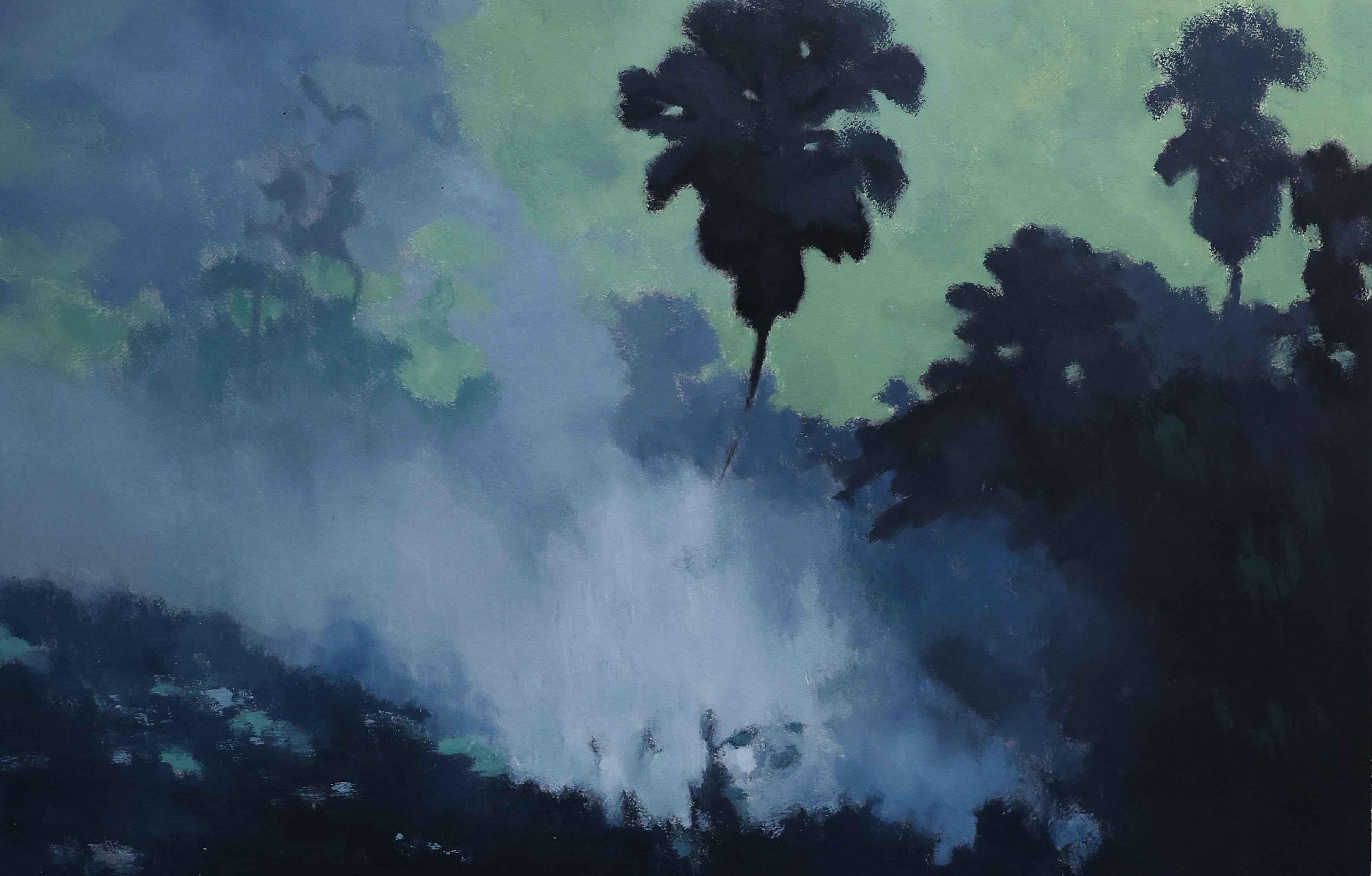
When the Tropics Refuse Paradise
Erick Víquez on landscape, painting, and the weight of inherited narratives.

Can the tropics be Gothic?
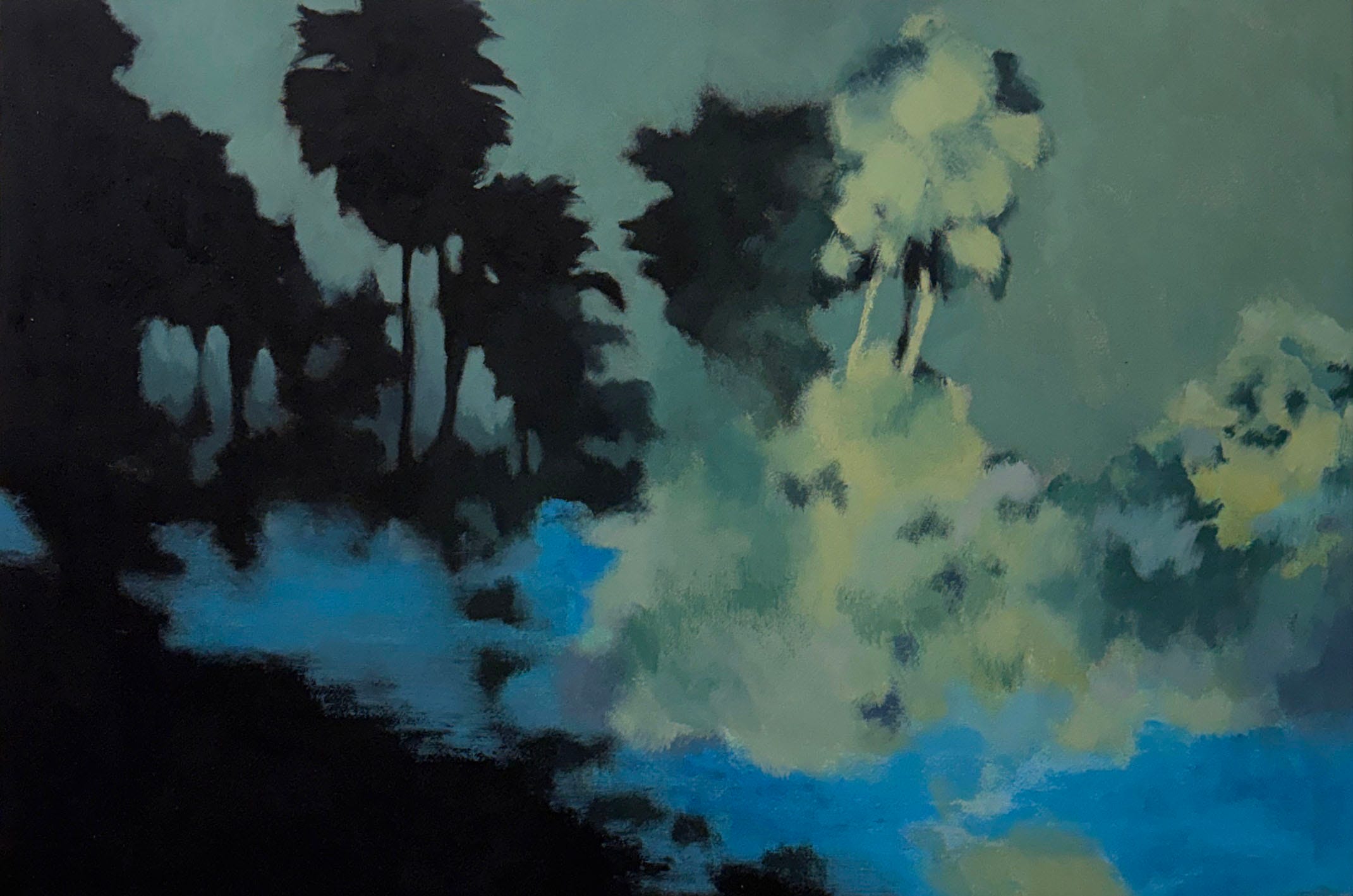
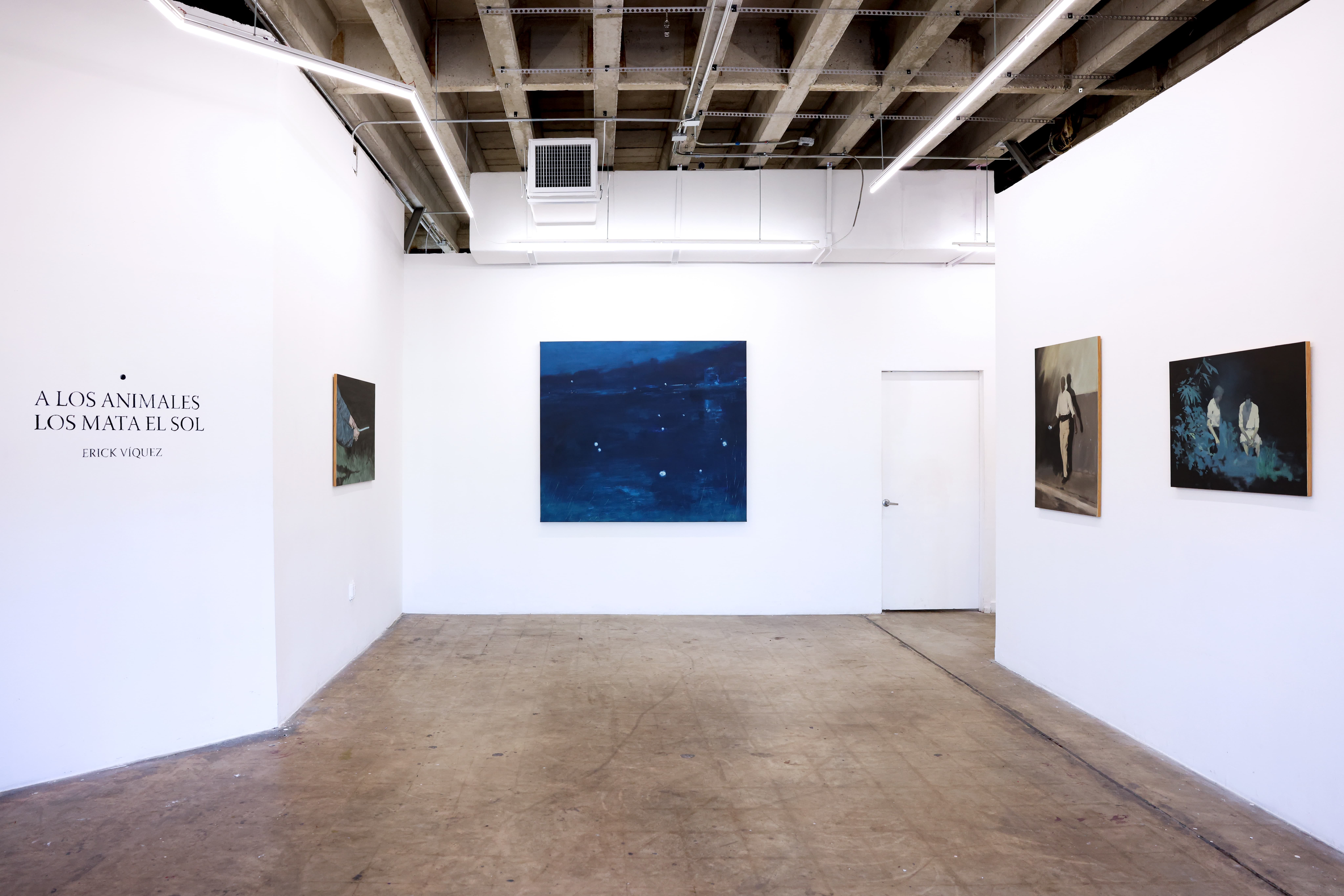
It wasn't a question I had ever asked myself until I visited Costa Rican painter Erick Víquez's exhibition A Los Animales los Mata el Sol (Animals Die in the Sun). As curator Amanda Garcia walked me through the exhibition, she mentioned one of its references: Tropical Gothic. The phrase seemed contradictory, bringing together two worlds that rarely meet in the imagination.
Bringing together twenty new paintings and drawings, the exhibition unfolds across rural landscapes where light is constantly shifting: filtered through trees, reflected in water, or giving way to shadow. Figures drift through these spaces with a quiet, almost dreamlike presence. What stayed with me most was the sense of something always just beyond view, present in the stillness of the figures, as if they were waiting for something the paintings never quite show.
Looking into the term's origins, I discovered the work of Colombian filmmakers Carlos Mayolo and Luis Ospina. Their cinema relocated the Gothic from castles and fog to colonial histories, tropical heat, and landscapes haunted by memory. The tropics were no longer paradise but a place where beauty and unease shared the same terrain.
But speaking with Víquez complicated that first impression.
While he acknowledges Tropical Gothic as one of the exhibition's references, our conversation soon turned elsewhere. Again and again, he returned to painting itself and to the landscape, not as a symbol or a psychological projection, but as a force with its own presence. Rather than asking what the landscape means, he was interested in what it is once inherited narratives begin to fall away.
This shift quietly reshapes the exhibition. The paintings resist the role the tropical landscape has so often been asked to play: paradise, abundance, origin, escape. “The tropics as promise,” he tells me, “is a cultural coding.” His interest lies in what remains once those codings collapse.
Beyond its cinematic references, Víquez's paintings open onto a broader set of questions. Drawing on literature, philosophy, and the history of landscape painting, they challenge familiar ways of seeing the tropics. Rather than illustrating ideas, the paintings create space for ambiguity, inviting viewers to linger in what cannot be immediately resolved. I spoke with Víquez about these influences, his practice, and the questions that shape this body of work.
Carmen de Terenzio: The exhibition references writers and filmmakers associated with Tropical Gothic, yet the paintings never become overtly narrative. Instead, the atmosphere seems to carry much of the meaning. Your paintings feel cinematic without looking like film stills. What can painting do with mood, ambiguity, and psychological tension that literature or cinema cannot?
Erick Víquez: I don’t believe there is anything that painting can do, in strictly formal terms, that cinema or literature cannot. What distinguishes it, rather, is its objecthood: a quality that emerges from the very act of painting and carries an entirely different kind of weight. It has to do with presence. What might be described as atmosphere in these paintings is not a calculated effect but a consequence of the process itself.
Painting presents itself as an invocation, as the total impression of an image before it becomes something to be read or interpreted.
Rather than insisting on the autonomy of painting, I find it more productive to compare it with literature. Painting has much to do with editing: letting go of the initial idea and accepting that its greatest distinction lies in improvisation, whim, and instinct. Paradoxically, this is where painting’s intellectual rigor resides—in that space of improvisation where the gesture remains inscribed on the surface. Naturally, this way of painting shapes the atmosphere of the image. It also requires areas of deprivation, passages free of prescribed meaning, so that the viewer may bring something of themselves and establish an elliptical relationship with the work.
CDT: Many of your paintings depict tropical environments, yet they resist the sense of abundance or paradise often associated with the region. What interests you about approaching the landscape as a psychological space rather than a descriptive one?
EV: The distinction between psychological space and descriptive space is, to some extent, misleading. I do not begin from the assumption that description and psychology are separate registers. Rather, they collapse into one another: the landscape is neither an object to be described nor a screen for subjective projection, but a force that generates both simultaneously.
The tropical landscape already arrives heavily overcoded: paradise, abundance, light, promise. Any honest engagement with it has to work against that coding. That task is not psychological so much as ontological; it concerns the reality of the landscape itself. My interest is not in what the landscape makes us feel, but in what the landscape is once it is stripped of the representational function imposed upon it.
In that sense, I work from the idea that the American landscape is impatient for its own expression. It does not wait to be described or interpreted; it acts on its own terms. The tropics as promise, origin, paradise—those are cultural codings. What deserves attention is what remains once those narratives collapse under their own weight: the landscape with its own density, its own darkness, its own indifference. It is not the subject projecting psychology onto the landscape; it is the landscape acting upon the subject.
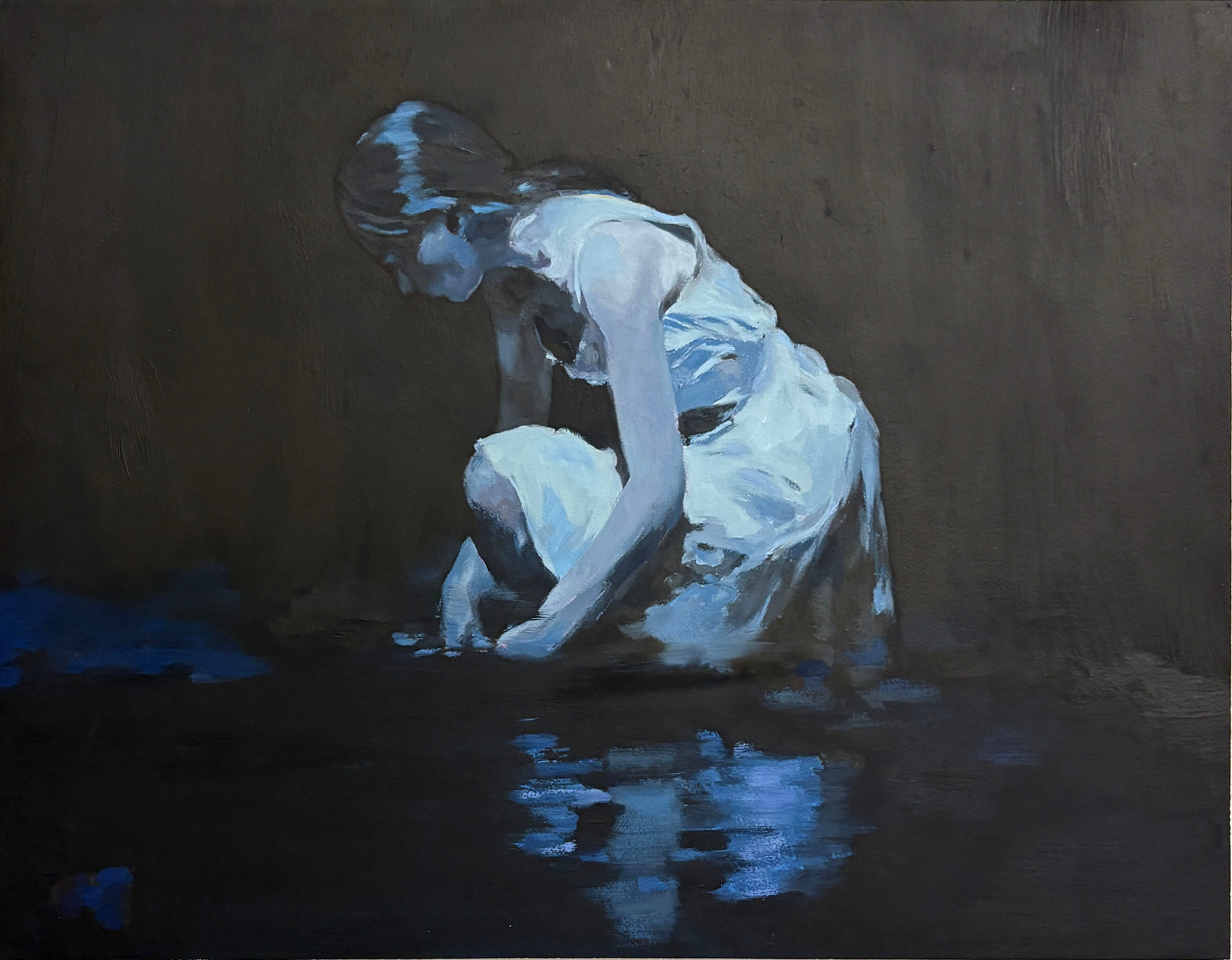
CDT: The figures in these paintings often appear partially obscured by darkness, water, reflection, or shadow. They seem suspended between presence and disappearance. How do you decide how much a painting should reveal and how much it should withhold?
EV: I think of the sigh: one paints in a sigh, which is a form of emptiness. The image must also be an act of concealment; one paints by erasing as much as by adding. Whoever looks at a painting should have access to only part of it, never to everything that is expected to be seen. In the same way that a sigh lingers after the air has been expelled, the viewer senses that the image's incompleteness endures, becoming something layered. Among the painter's abilities is the capacity to suppress events within the canvas without putting the image at risk.
Painting, for me, is fundamentally an exercise in re-signifying the image. We are surrounded by images that function primarily as propaganda or one-way information. Painting should instead preserve spaces of uncertainty and edges that make room for mystery.
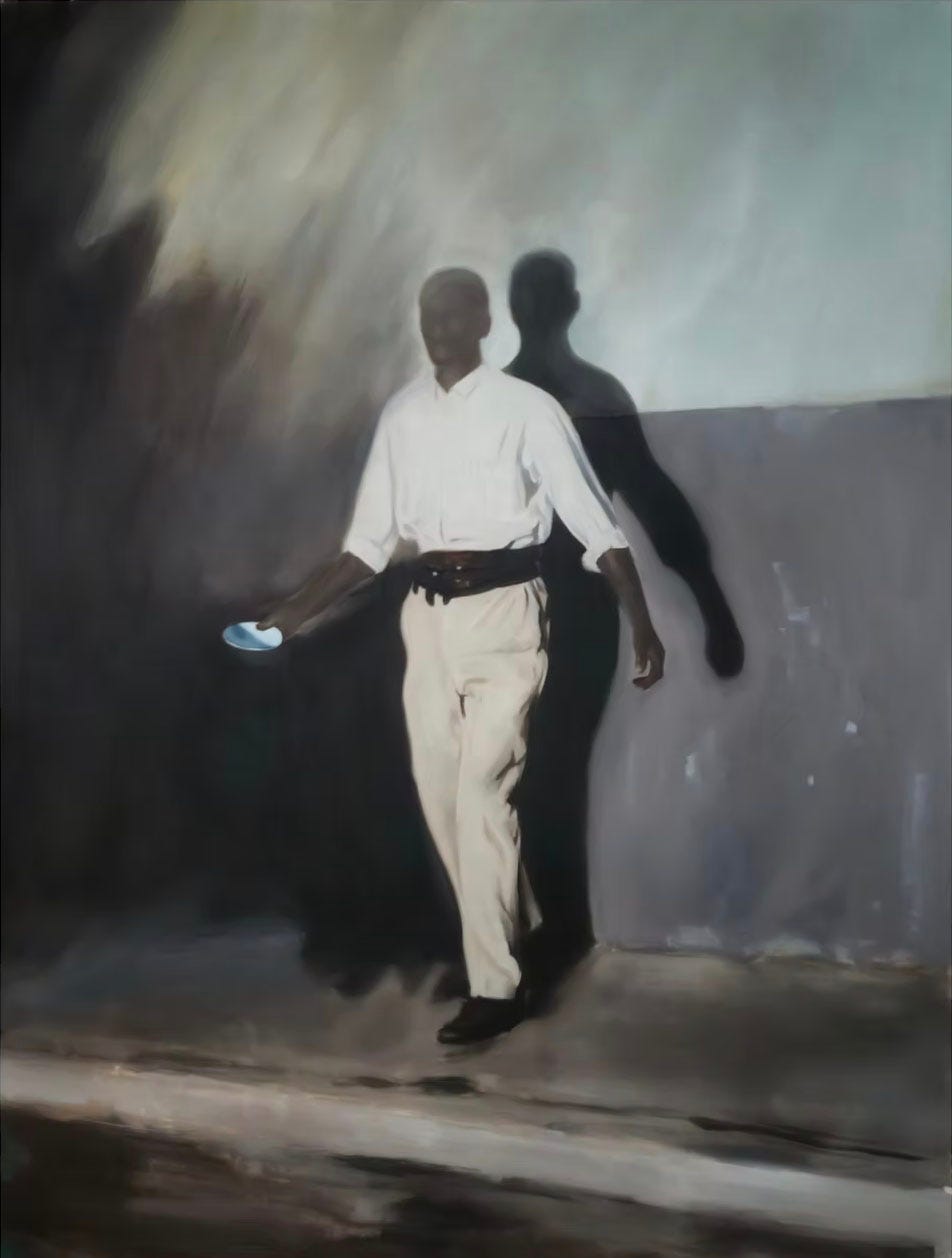
CDT: One painting in particular seemed to gather many of the exhibition's concerns into a single figure (Untitled, 2026, shown above). A nearly faceless man dressed in white walks through a hazy landscape, holding what appears to be a small disk or plate. His shadow trails behind him, but not quite as expected. Could you tell me about this work?
EV: This figure carries something of the first man, the one already separated, already in exile. He’s holding a mirror: a primitive instrument for navigation and in a way the first technology of orientation, of locating oneself in relation to something outside the self. My initial idea was to talk about a proto-religious impulse; the moment before doctrine, when the human animal first attempted to read the world rather than simply inhabit it.
The shadow behind him doesn't quite match his body. That discrepancy runs through the whole exhibition. The figure in exile remains partially illegible; there's a suspension between dissolution and presence that repeats in other paintings.
CDT: The exhibition takes its title from Max Jiménez's El Jaúl*, a novel that challenged idealized visions of rural Costa Rica. What aspects of rural memory, folklore, or mythology continue to resonate with you, and what inherited narratives about the countryside are you interested in questioning?
EV: Perhaps my interest lies in recognizing a persistence: the countryside was not first idealized and only later corrupted. It always possessed that crepuscular quality, and Jiménez was able to perceive it when others chose to look away.
My work belongs to a visual and imaginary tradition that has long questioned inherited narratives about rural life because the underlying condition has not fundamentally changed. The failed civilizing project, the fall from grace, latent violence, and a religiosity long confronted by successive regimes of land and labor exploitation — all continue to structure this landscape. My paintings inhabit a landscape that resists luminosity, where people are left to their own devices with rudimentary tools.
The pastoral image of the countryside, together with the figure of the peasant as the foundation of national identity across much of Latin America, was largely a political construction. It never fully corresponded to the lived reality of rural life. In my paintings, the landscape does not affirm belonging, origin, or the promise of continuity. Rather, it becomes a space where those categories lose their authority. My interest is not in replacing an idyllic countryside with a sinister one, but in freeing the landscape from its identitarian function altogether.
I should add a distinction that matters to me: while Tropical Gothic appears as one of the exhibition’s references, the category I find more precise for my own work is Rural Gothic. Tropical Gothic, as Mayolo and Ospina developed it, is fundamentally a relocation — Gothic conventions transplanted into the tropical, corruption and unease arriving from outside. What interests me is a darkness that emerges from within the rural landscape itself, from its structural violence, its particular religiosity, its relationship to labor and land. Jiménez was already working in this register in the 1930s, independently of any cinematic tradition. The condition he saw hasn’t changed.
At the same time, this exhibition marks a shift within my own practice. While earlier works approached the landscape through a more explicitly historical or critical lens, this body of paintings opens onto other dimensions. Much of that shift owes itself to Amanda, whose selection of the works discerned the possibility of reading them as fragments of a rural romance unfolding in the tropics. That reading allowed me to recognize that this body of work also speaks of loss, exile, and forms of elemental intimacy between people attempting, almost from nothing, to invent a way of inhabiting the landscape. Those early conversations revealed what the exhibition itself required: more reverie, more distant eros, and a greater stillness.
CDT: Water appears repeatedly throughout these works, not simply as a landscape element but as a space of reflection, concealment, and transformation. What draws you to water as an image, and what possibilities does it offer that the land does not?
EV: Water does not particularly interest me as an image in itself. It appears because it is a constitutive element of the landscape in which I live and think: the humidity, the rain, and the quality of light that water casts across surfaces and bodies. If water evokes ideas such as origin, the womb, or silence, these are not points of departure but possible consequences of something more elementary: water alters light and the human figure in ways no other element of the landscape can. It dissolves contours, suspends the distinction between inside and outside, and produces a darkness that is not the absence of light but another quality of it.