

Inherited Geometry
A reflection on perception, lineage and the echoes of Neo-Concretism.

How does an artist learn to see: through training or through something deeper passed on without notice? That question emerged after visiting Maritza Caneca’s studio at the Bakehouse Art Complex with art historian and fellow writer Clare Elson (Snap Art and Artists), whose interview with Caneca you can read here. Surrounded by her photographs, I felt a sensation I couldn’t immediately name: a kind of visual echo, a familiarity embedded in the geometry of her pools.
It was then I realized that geometry in Brazilian art is not simply a language; it’s a kind of genetic code. For artists who came of age in the decades following Neo-Concretism (1970s and 1980s), geometric abstraction feels instinctive, as if absorbed through the eye rather than learned. Its roots reach back to Rio de Janeiro’s Grupo Frente, where in the late 1950s artists such as Lygia Clark, Lygia Pape, and Hélio Oiticica broke with the strict rationalism of Concrete Art to form the Neo-Concrete movement. They sought something more human—an art that could breathe, move, and touch. As Ferreira Gullar wrote in his Theory of the Non-Object (1959), the work of art was not a thing but “a synthesis of sensorial and mental experience.”¹ It was a way of feeling thought; of making thought visual.
Neo-Concretism was the moment when geometry in Brazil stopped being cold and became sensorial. It replaced intellectual distance with bodily engagement, with the idea that perception itself was creative. That shift, born in postwar Rio, still reverberates in artists like Caneca, who carry that inheritance almost unconsciously. What began as a rebellion against rigidity became a way of seeing—an understanding that structure could hold emotion, and that abstraction could speak in human terms. This was the legacy of Grupo Frente: to turn geometry into language, to let form feel.
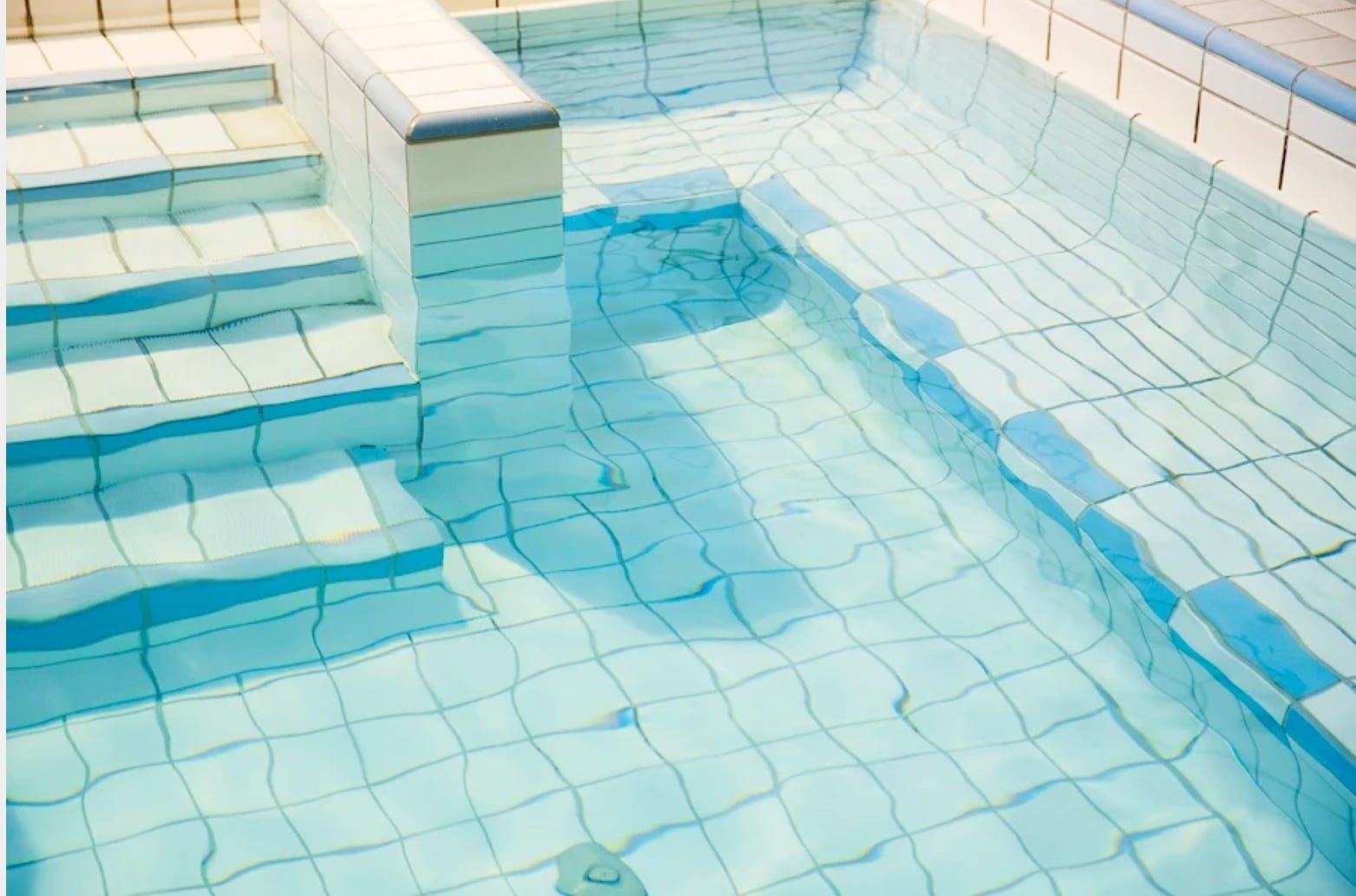
A former cinematographer, Caneca composes with the discipline of the frame and the fluidity of water. In one photograph, the tiled steps of a pool curve beneath the surface, the grid trembling with the light’s refraction. In another, a lap pool stretches across the frame, its red and blue lane dividers forming an accidental abstraction: part architecture, part rhythm, like a flag dissolving into reflection. The photographs unfold like scenes from a silent film, each one suspended between stillness and movement.
Standing before these images, I thought about how Brazilian abstraction has always sought the meeting point between order and feeling. Neo-Concretism replaced logic with sensation, and Caneca’s pools may have inherited that logic. Their tiled surfaces are alive with reflections that never repeat, their stillness disturbed by memory. In her work, geometry resurfaces, refracted through light and the lingering idea that order, too, can feel. And maybe that’s what I sensed in her studio that afternoon: a way of seeing shaped by training, yes, but also by something older weaving its way forward.
Read here Elson’s interview with Caneca.