


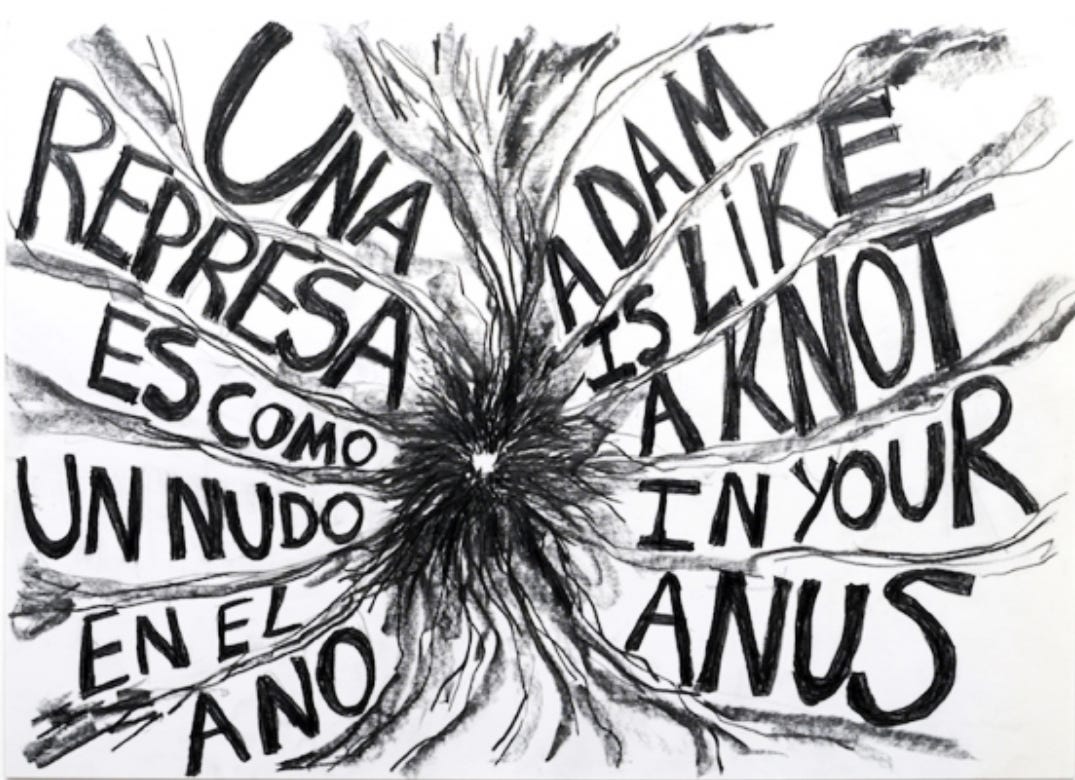
While art may not always form community, it may give communities a way to take form. But what does that actually look like? Who gets to participate in defining that community? And what happens to a community when the relationship between people, labor, and territory is radically altered by a large technological intervention?
These were some of the questions that stayed with me after attending ICA Miami’s Summer Intensive, From Oil to Electricity: Cultural Form and the Politics of Energy in Latin America, led by visiting faculty Victoria Saramago and Santiago Acosta. The seminar looked at how energy, from oil and hydroelectricity to renewable technologies, has shaped art, culture, and the environment across Latin America. What did the different works we encountered teach me about what community actually is? The seminar covered much more; these are simply the ideas I chose to follow. Amidst unfinished sentences (I’m sure there’s a science to taking notes while someone is talking) and, thankfully, many finished ones, here are some of my finds.
Carolina Caycedo’s work along Colombia’s Magdalena River was one of the examples that stayed with me. Communities there had lived for generations in close relationship with the river, through fishing, farming, work, and everyday life. The construction of the El Quimbo hydroelectric dam threatened not only homes and livelihoods, but those relationships. In response, groups such as ASOQUIMBO and Ríos Vivos protested and organized, but they also found ways of holding on to what was being lost. They walked together along the river, retracing places and memories, keeping knowledge of the territory alive.
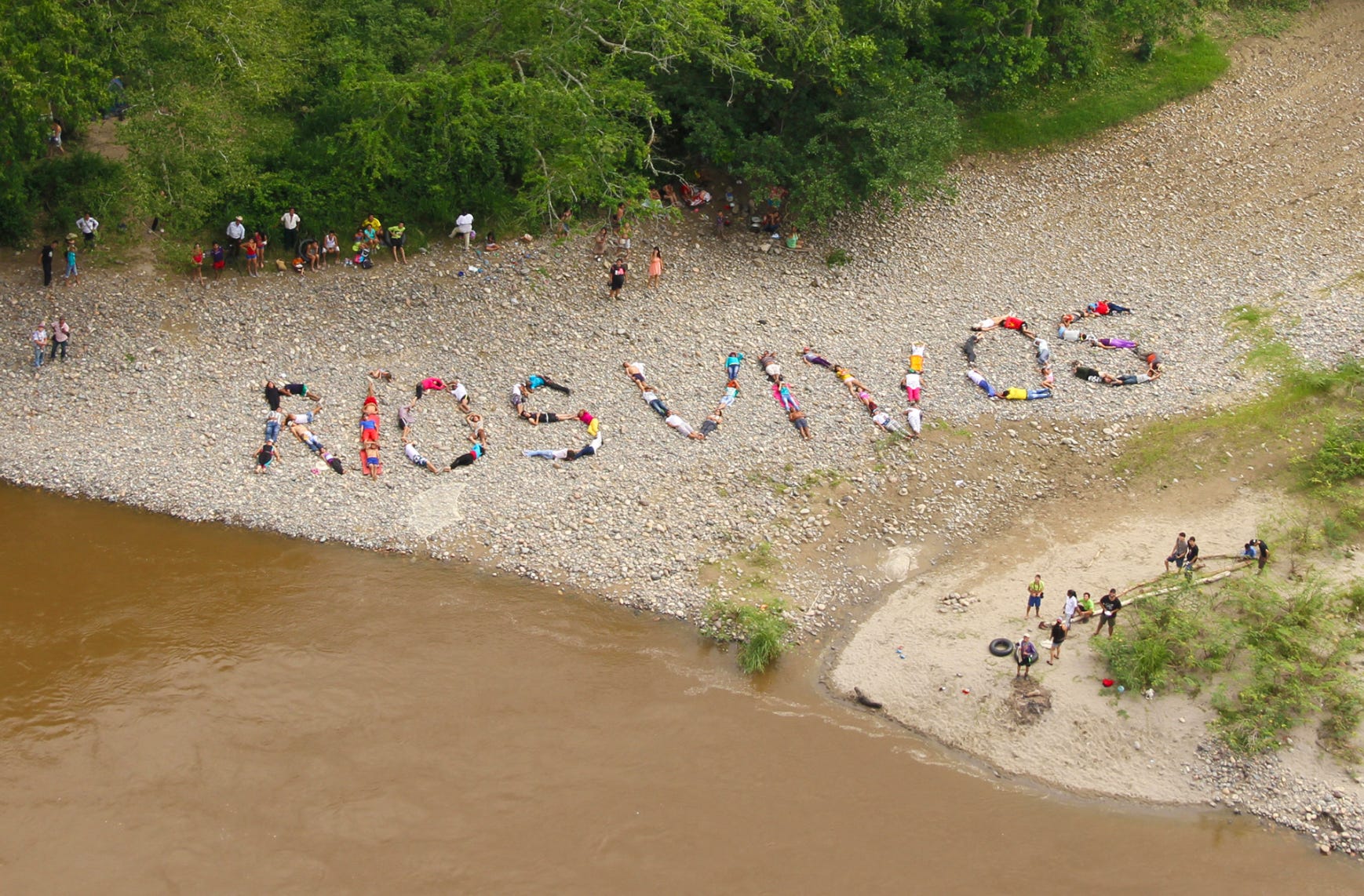
Caycedo began working with some of these communities rather than simply making work about them. In 2014, she collaborated with Descolonizando La Jagua and residents of towns affected by the dam on what she calls “geo-choreographies.” Through workshops, people developed performances together, using their bodies and movement to tell stories about the river, displacement, and their connection to the land. Macarena Gómez-Barris calls these “spaces of communal meaning”,1 a phrase that stayed with me. There is something simple and powerful in it: people walking together, moving together, remembering together. The artwork becomes a place where those experiences can meet.
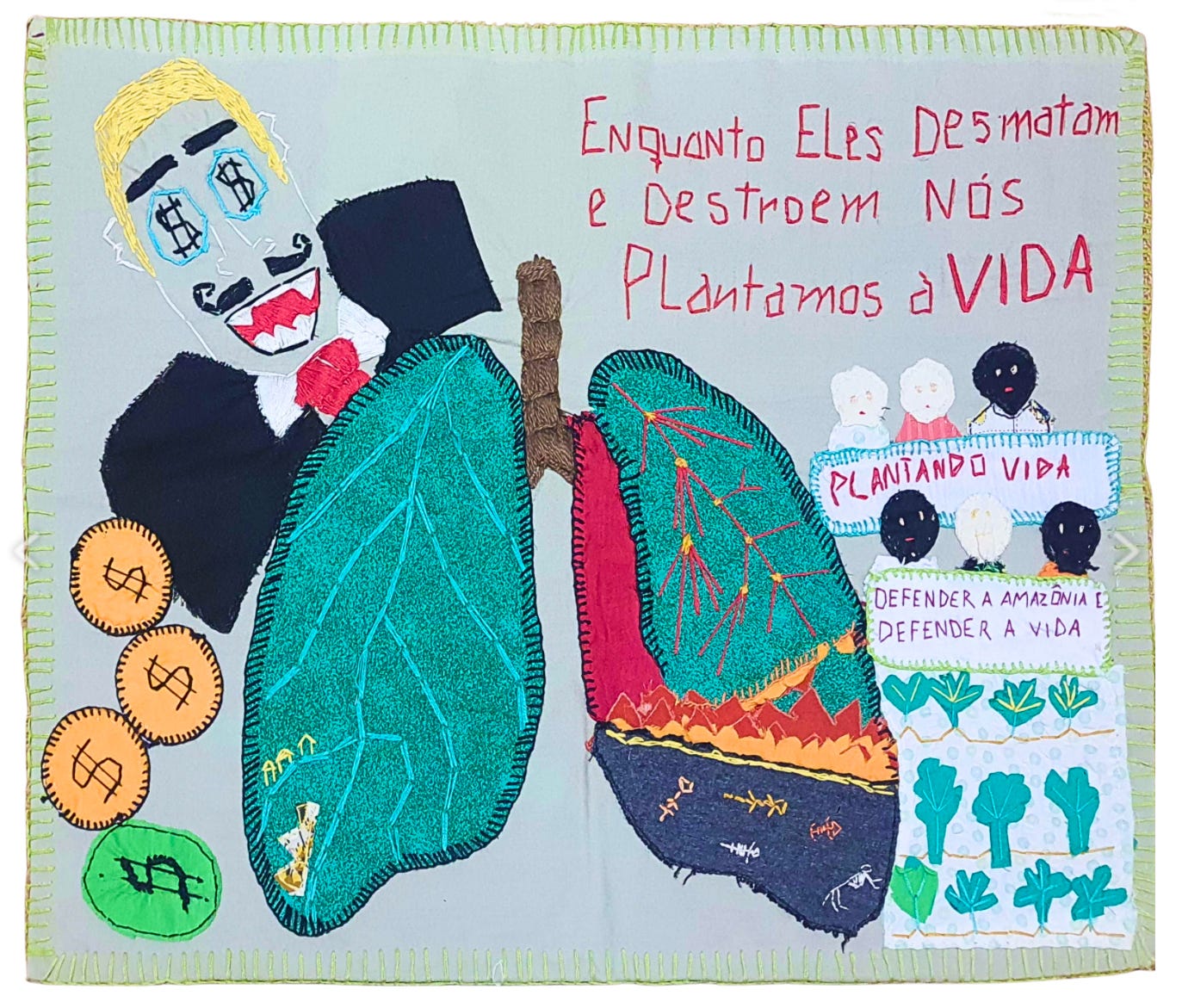
Then there were the arpilleras. Pieces of fabric, bits of clothing, thread, burlap—and stories. Since 2013, women affected by the construction of dams across Brazil have been gathering to sew their experiences into cloth. They belong to the Movimento dos Atingidos por Barragens (Council of Women of the Movement of Dam Victims), and their arpilleras tell of homes left behind, changing landscapes, work, family, violence, but also resistance.
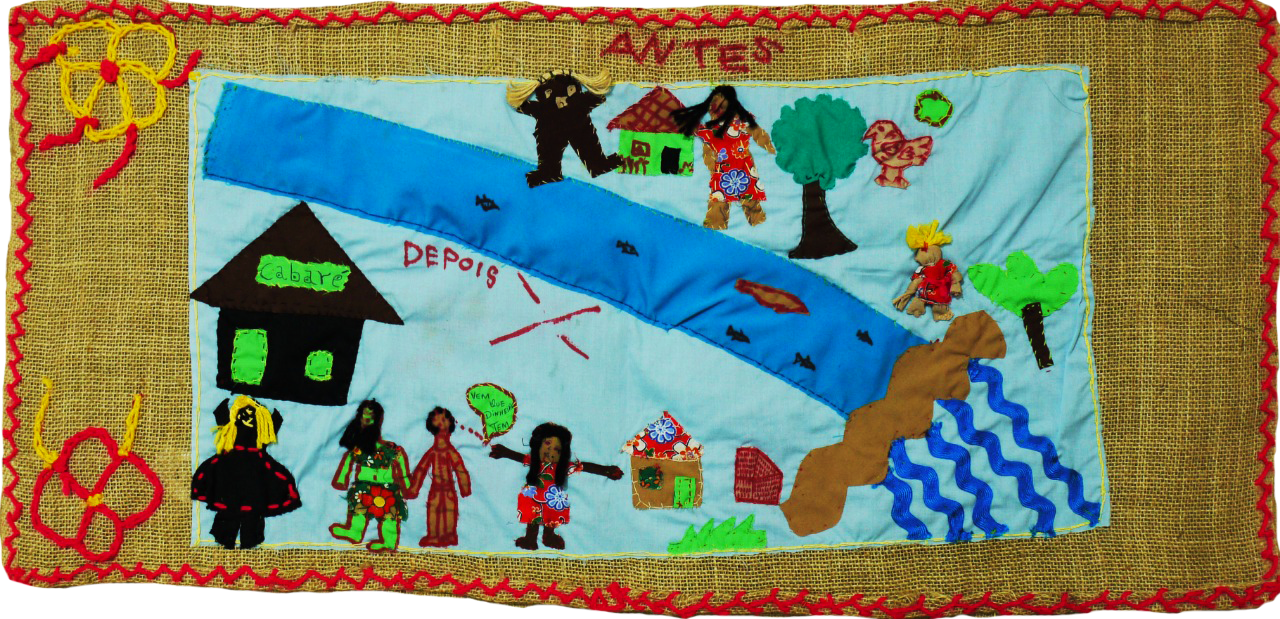
The women talk about what has happened to them and decide what to put into cloth. Sitting together, remembering, sharing, deciding what matters, sewing one person’s experience beside another’s —these aren’t preparations for the artwork. They are part of the artwork.
This made me think about community a little differently. Making art can itself be a way of forming it, or, in this case, of trying to hold a community together after dams have threatened or broken the relationships that sustained it. Sewing becomes a way of telling, but also of listening. Something that might have been endured privately is placed beside someone else’s experience and becomes shared. The finished arpillera may eventually travel to an exhibition, a meeting, or a protest, but perhaps its first audience is the women sitting around it.
Tomás Saraceno’s Museo Aero Solar begins somewhere quite different. Since 2007, people around the world have come together to make enormous floating structures from used plastic bags, contributing their own bags, messages, and stories. Saraceno calls the process Do-It-Together 2 rather than Do-It-Yourself, which may be what I like most about it. Here, the participants don’t necessarily begin as a community; for a moment, the making creates one. One bag doesn’t amount to much. Joined to thousands of others, it can lift something into the air.
But there is a tension: Museo Aero Solar begins with Saraceno’s idea, and communities are then invited into it. Participation, after all, doesn’t necessarily make something collective. Who proposes the work, who makes decisions, and who has ownership of what emerges still matter.
Margot Benacerraf’s 1959 film Araya seems, at first, to belong somewhere else entirely. It is not participatory art. Benacerraf observes families living on Venezuela’s Araya Peninsula, where for generations life had been organized around the salt flats and the sea. Men rake and carry salt beneath an unforgiving sun; women weigh and sack it; fishermen leave before dawn; water and food move through households. The film follows a single day, and through its repetitions something gradually becomes visible: no life there exists entirely on its own.
Perhaps that is why Araya belongs in this conversation. Community here is not an event but interdependence. Salt, sea, sun, labor, food, family, and inherited knowledge are woven together, one person’s work passing into another’s life. Benacerraf catches a community just before the relationships that sustain it begin to change. Mechanization is beginning to transform salt production, but what the film preserves is more than a disappearing way of working, it's a record of how deeply one life depends on another.
But when does participation actually become community? Perhaps when people are not simply invited in, but have a say in what takes shape: the stories that are told, the knowledge that is carried forward, even the artwork itself.
These works make it difficult to imagine any place as empty. Yet terra nullius—land belonging to no one—rests on precisely that fiction. A river can be dammed, a valley flooded, a landscape remade when what is already there is made invisible: nature, memory, labor, knowledge, relationships, ways of living.
Somewhere among my unfinished sentences, community had become less a thing to define than something to notice: in people walking together, sewing around a table, joining one small piece to another, or simply depending on one another to make a life possible. Maybe art creates community in more ways than I had imagined: by giving us a way to practice it, hold on to it, rebuild it, or simply recognize that it is already there.
1 Macarena Gómez-Barris, “A Fish-Eye Episteme: Seeing Below the River’s Colonization,” in The Extractive Zone: Social Ecologies and Decolonial Perspectives (Durham, NC: Duke University Press, 2017), 107.
2 Azucena Castro et al., “Energy Sovereignty Storytelling: Art Practices, Community-Led Transitions, and Territorial Futures in Latin America,” Tapuya: Latin American Science, Technology and Society 7, no. 1 (2024): 12–14.
How do you know when you belong to a community? What creates that sense of belonging for you?